Modern living demands flexibility, resilience, and an unwavering ability to transition between drastically different environments within a single day. A typical morning might begin with an early commute, progress into back-to-back professional meetings, shift toward running personal errands, and conclude with an evening social event or workout session. Navigating this multi-faceted lifestyle requires gear that adapts to every setting without compromising style or functional efficiency.
Among all accessories designed for daily transport, one design has maintained an enduring presence across generations and fashion trends: the classic tote bag. Characterized by its open-top architecture, dual handles, and spacious interior, the tote bag is often celebrated as the ultimate everyday carry. However, as lifestyle demands evolve, modern women are increasingly evaluating whether this timeless silhouette remains the best solution for personal utility, or if alternative carry options offer superior ergonomics and organization.
Below, we examine the functional mechanics, practical trade-offs, and versatility of the classic tote bag to determine whether it truly reigns supreme as the ideal daily carrier for women on the move.
What makes the classic tote bag layout so naturally practical for daily use?
To understand the widespread popularity of the tote bag, one must look closely at its fundamental structural design. Unlike complex bag architectures featuring dozens of specialized compartments, rigid dividers, and intricate locking mechanisms, the classic tote centers on structural simplicity: an open, cavernous main compartment supported by two sturdy parallel handles.
The Unrestricted Storage Cavity
The primary appeal of a tote bag lies in its unobstructed interior space. Because the main compartment is typically free of rigid internal dividers, it allows users to carry irregularly shaped items that simply would not fit into more structured briefcases or segmented backpacks.
Volumetric Adaptability: A single interior space easily accommodates a laptop, a change of shoes, a cosmetics pouch, a water bottle, and a compact umbrella simultaneously.
Rapid Access: The absence of complex top flaps or multiple zippers means you can reach inside and retrieve items instantly without pausing your stride.
On-the-Fly Expansion: The supple sidewalls of traditional tote materials-such as structured canvas, full-grain leather, or durable synthetics-flex outward to accommodate unexpected daily additions like groceries or documents.
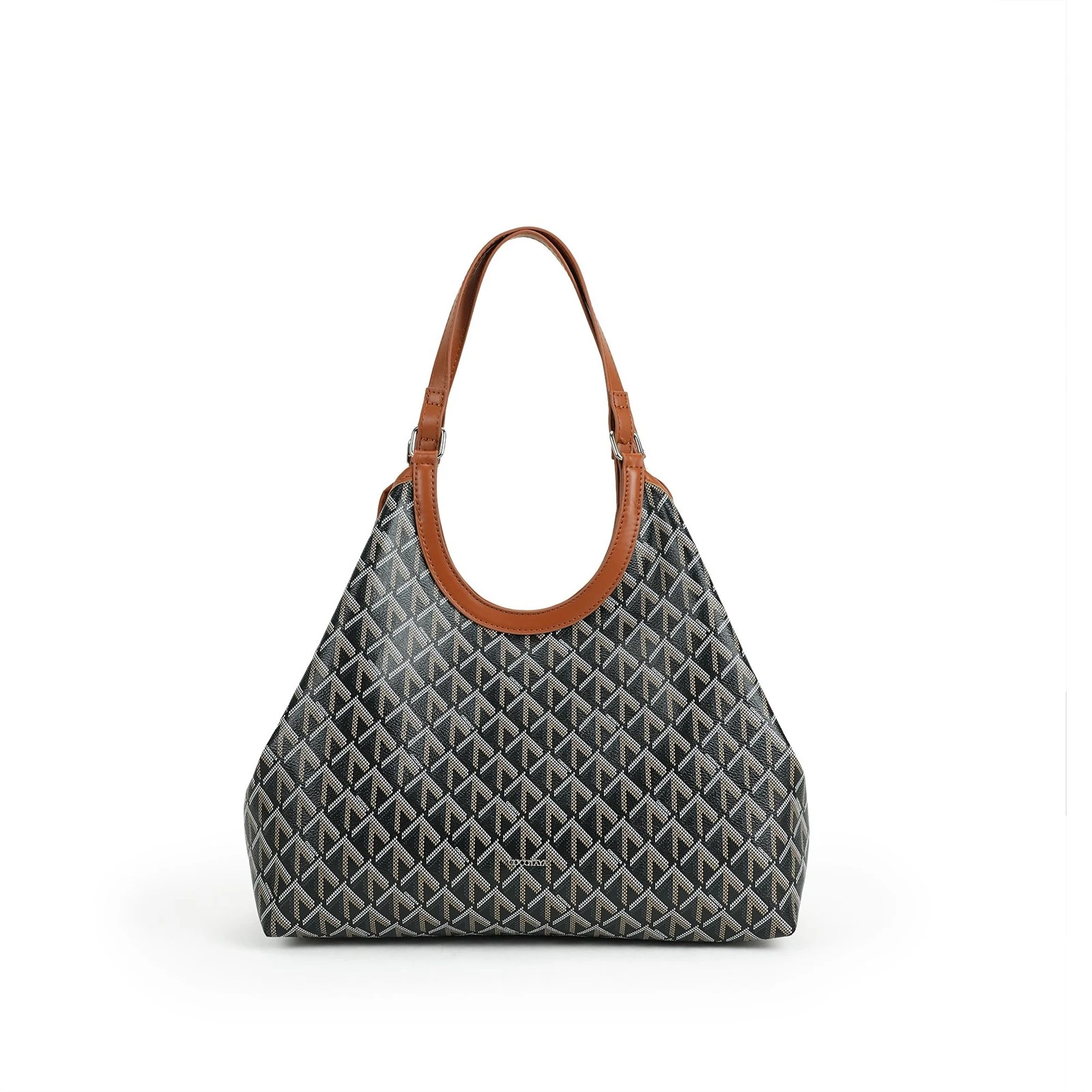
This vintage-inspired tote bag features a classic, all-over geometric monogram pattern. Set against a sophisticated, understated base, the design incorporates a diamond-grid motif woven with light gray and beige-brown lines-a highly recognizable look that exudes a sense of "quiet luxury" and retro charm. The bag is accented by a warm, brown-toned shoulder strap, creating a subtle, harmonious color contrast. Equipped with a metal adjustable buckle, the strap allows for a customized fit, ensuring a comfortable and effortless carry. Designed with a soft, open-top "hobo" silhouette, the bag expands naturally at the base to offer ample capacity-perfect for holding all your daily essentials for commuting or travel-while striking a balance between practicality and a relaxed, laid-back aesthetic. Crafted from durable, low-maintenance material, the bag boasts clean, minimalist lines free from excessive ornamentation, resulting in an understated, timeless appeal. Highly versatile, it is well-suited for a variety of occasions, from daily commutes and shopping trips to short excursions.
Uncompromising Exterior Aesthetic
From an aesthetic perspective, the classic tote offers a seamless blend of minimalism and sophistication. Its clean lines and balanced proportions allow it to transition effortlessly across varying dress codes. Whether paired with tailored business attire, casual weekend wear, or athletic apparel, the simple geometry of a well-crafted tote complements virtually any wardrobe without clashing.
How does the tote compare to backpacks and crossbody bags for urban mobility?
When selecting a daily utility carrier, modern women often weigh the classic tote against two primary competitors: the urban backpack and the hands-free crossbody bag. Evaluating how these three styles perform across real-world scenarios reveals key functional distinctions.
Ergonomics versus Accessibility
The key distinction between a tote and a backpack lies in the trade-off between weight distribution and immediate item access. Backpacks distribute weight symmetrically across both shoulders and the spinal column, making them superior for long-distance walking or heavy load transportation. However, retrieving an item from a backpack requires removing the bag entirely, which can be cumbersome in crowded public transport or fast-paced work settings.
Conversely, a tote bag rests under one arm or hangs from the shoulder, positioning the bag's opening within arm's reach. This positioning allows you to pull out a transit card, phone, or set of keys in seconds while remaining completely mobile.
Carrying Capacity versus Agility
When compared to crossbody bags, the tote holds a clear advantage in total volumetric capacity. While crossbody styles excel at keeping essential personal items secured close to the body, their smaller physical footprints make carrying larger daily tools-such as laptops, notebooks, or meal containers-nearly impossible. The tote provides the necessary volume for full-day readiness while retaining a lower profile than bulky travel duffels.
Can structured internal organization solve the common "bottomless pit" dilemma?
Despite its many advantages, the traditional open-compartment tote possesses a widely acknowledged design vulnerability: small items frequently sink to the bottom, creating clutter and frustration when searching for specific belongings.
Modular Organization Strategies
To solve this issue without sacrificing the tote's signature spaciousness, many modern users adopt modular organization techniques. Using self-contained accessory pouches allows users to categorize their belongings systematically:
Tech Pouch: Dedicated to chargers, cables, power banks, and adapters.
Personal Care Pouch: Houses cosmetics, hand sanitizers, lip balms, and personal hygiene items.
Essentials Sleeve: Keeps wallet, passport, and vital identification cards organized and easily transferable.
Insert Organizers and Built-in Features
In addition to modular pouches, felt or fabric handbag inserts have transformed tote usability. These removable inserts line the interior walls of the tote, adding structured pockets for water bottles, pens, smartphones, and notebooks. By combining a classic exterior tote shell with a removable internal insert, users enjoy the structured organization of a briefcase alongside the flexible storage of an open tote.
What materials offer the optimal balance of durability, weight, and style?
The long-term success of a daily carrier depends heavily on material selection. Because a daily utility bag encounters diverse environmental conditions, daily wear, and variable weight strains, selecting the right fabric or leather is paramount.
Full-Grain and Top-Grain Leather
Leather remains one of the most classic choices for professional totes due to its durability, structure, and polished aesthetic.
Pros: Highly durable, develops a unique patina over time, maintains shape, and fits seamlessly into formal corporate environments.
Cons: Inherently heavier when empty, requires periodic maintenance, and can be susceptible to water damage if untreated.
High-Density Canvas and Cotton Twill
Heavyweight canvas provides a time-tested alternative that favors lightweight flexibility and casual utility.
Pros: Lightweight construction, high tensile strength, easily washable (depending on lining), and highly resilient against abrasions.
Cons: Less structured, absorbs moisture unless treated with water-repellent coatings, and offers a more informal aesthetic.
Technical Nylon and Synthetic Blends
Modern performance fabrics have introduced a new tier of functional utility totes designed for rigorous daily use.
Pros: Exceptionally lightweight, naturally water-resistant, easy to wipe clean, and highly resistant to tear forces.
Cons: May lack the formal structure required for conservative professional environments and can lack breathability against clothing.
Why does handle design play such a crucial role in long-term carrying comfort?
A tote bag's handle architecture is the single most critical touchpoint influencing user comfort. Because the entire load of the bag relies on these straps, minor variations in width, drop length, and attachment construction significantly affect physical comfort during prolonged use.
Strap Width and Pressure Distribution
Narrow straps tend to concentrate weight onto a thin line across the shoulder, leading to muscle tension and discomfort when carrying heavier items like laptops or full water bottles. Broader, flat straps distribute the downward force across a wider surface area, reducing localized pressure and preventing the handles from digging into the shoulder.
Handle Drop Length
The "drop length"-the vertical distance between the top of the handles and the top edge of the bag-determines how the tote hangs relative to the arm and torso:
Short Drop (5–7 inches): Intended primarily for hand carrying or crook-of-the-elbow wear. While aesthetically elegant, it limits shoulder-carrying capacity, especially when wearing winter coats or heavy outerwear.
Optimal Drop (8–10 inches): Allows the tote to slide smoothly over the shoulder and rest comfortably under the arm, securing the bag against the body without restricting movement.
Extended Drop (11+ inches): Provides ample space for bulky outerwear but can cause the bag to sit too low on the hip, increasing momentum and sway while walking.
Is the classic tote versatile enough to transition from work to wellness activities?
One of the greatest challenges facing active professionals is avoiding the need to carry multiple bags for different daytime activities. A successful utility carrier must accommodate professional items during work hours and easily adjust for personal or wellness pursuits before or after the workday.
The All-in-One Daily Ecosystem
The inherent flexibility of the tote bag allows it to function as a unified carrying solution for varied daily requirements:
Morning Commute & Office: Safely holds a laptop in a protective sleeve, documents, a planner, and personal accessories.
Fitness & Wellness: Accommodates lightweight workout apparel, resistance bands, or compact footwear without requiring an extra gym duffel.
Evening Socials & Errands: Collapses neatly against the body when partially emptied, maintaining a refined appearance suitable for dining or social gatherings.
By consolidating these needs into a single versatile carrier, users eliminate the risk of leaving important items behind in separate bags while streamlining their daily transit routine.
Is the Classic Tote Bag the Ultimate Daily Carrier?
When evaluated as a comprehensive daily utility solution, the classic tote bag excels in adaptability, accessible storage, and multi-setting style versatility. While dedicated backpacks offer superior dual-shoulder weight distribution for long hikes, and small crossbody bags provide unmatched lightweight agility, the tote remains uniquely capable of balancing professional presentation with expansive interior capacity.
For women seeking a single, reliable accessory that effortlessly moves through busy work schedules, urban travel, personal errands, and evening events, the classic tote bag proves itself not just as a traditional fashion choice, but as an indispensable tool for efficient daily living.