

Few fashion accessories occupy as prominent a position in everyday style as the shoulder bag. Resting comfortably under the arm or draped across the torso, a shoulder bag is a daily companion that carries personal essentials, defines silhouettes, and signals style preferences. Yet, when shopping for the ideal shoulder bag, consumers routinely face a fundamental choice: real leather or faux leather?
While factors like ethics, environmental footprint, and maintenance requirements heavily influence buying decisions, the ultimate verdict usually hinges on two tangible, practical dimensions: texture and price.
Understanding how genuine hides compare with synthetic alternatives across tactile feel, long-term wear, manufacturing processes, and initial vs. lifetime cost allows shoppers to make an informed, confident purchase.
Defining the Materials: What Are You Actually Buying?
Before contrasting tactile feel and market valuation, it is essential to understand the material composition of both real and faux leather.
Real Leather: Nature's Organic Composite
Real leather is produced by tanning animal hides-most commonly cowhide, though sheepskin, goat, and exotic skins are also used. Tanning transforms raw organic hide into a durable material resistant to decay.
Real leather is categorized into several primary grades based on which layer of the hide is used and how it is processed:
Full-Grain Leather: The highest-quality tier. It utilizes the topmost layer of the hide, keeping the natural grain pattern entirely intact. It retains natural imperfections, offers maximum breathability, and develops a rich patina over time.
Top-Grain Leather: The outer layer is sanded to remove surface blemishes before an artificial grain or protective topcoat is applied. It is slightly thinner and more uniform than full-grain leather, offering high durability with greater stain resistance.
Genuine (Split) Leather: Made from the lower layers of hide remaining after the top layer is split off. It is often heavily buffed, embossed with an artificial grain pattern, and coated with polyurethane or acrylic finishes.
Bonded Leather: Created by shredding leftover hide scraps, mixing them with bonding agents (like polyurethane), and pressing the mixture onto a fabric backing. It contains the lowest percentage of actual leather fibers.
Faux Leather: Synthetic Engineering & Plant Innovations
Faux leather (also termed vegan leather, synthetic leather, leatherette, or pleather) relies on human-engineered materials designed to mimic the appearance and structural behavior of genuine hides.
PU (Polyurethane) Leather: Made by coating a fabric backing (cotton, polyester, or woven mesh) with a layer of liquid polyurethane resin. PU leather is soft, flexible, relatively breathable, and easy to color or emboss.
PVC (Polyvinyl Chloride) Leather: Constructed by layering PVC with plasticizers and stabilizers over a structural fabric base. PVC leather is tougher, stiffer, and highly water-resistant, though less breathable than PU.
Bio-Based/Next-Gen Vegan Leathers: Innovations utilizing agricultural byproducts or mycelium (mushroom root structures), mixed with plant resins or bio-PU bases. These materials aim to match synthetic flexibility while reducing reliance on fossil fuels.
What Are the Texture & Tactile Experience Differences in Surface, Flexibility, and Sensory Cues?
The sensory experience of touching, wearing, and handling a shoulder bag forms a major part of its appeal. Here is how genuine hides and synthetic alternatives compare in texture.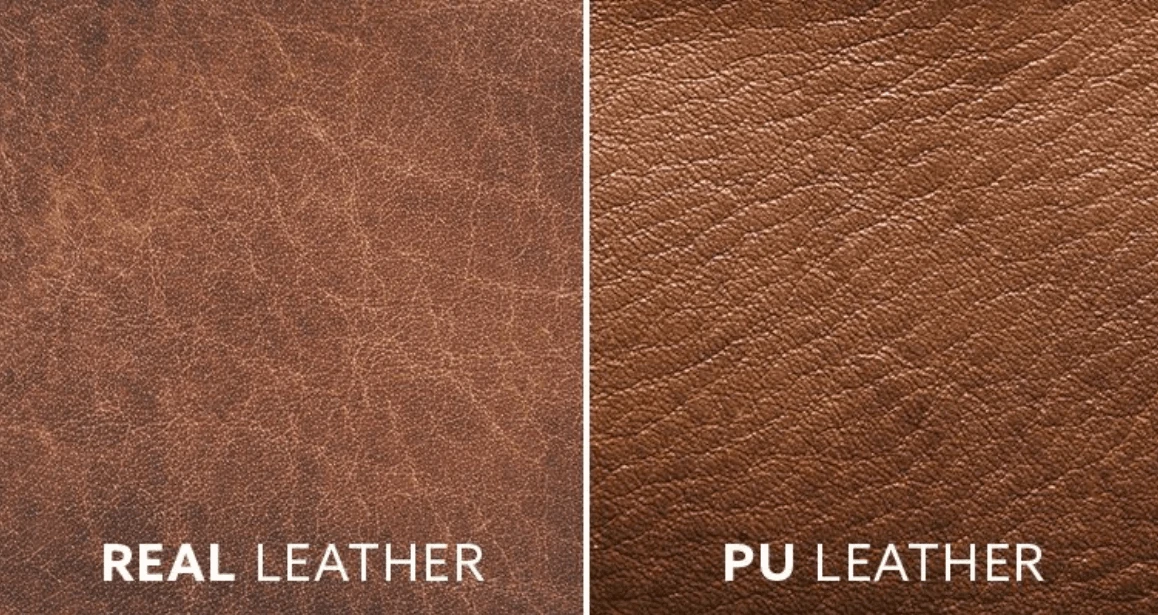
Organic Irregularity vs. Machine Uniformity
When inspecting a real leather shoulder bag closely, the grain texture is inherently asymmetrical. No two hides are identical. Microscopic pore structures, subtle shifts in grain density, natural stretch marks, and faint scars reflect the life of the animal.
Faux leather relies on mechanical embossing rollers to imprint grain patterns. Modern high-precision stamping can closely imitate pebble, saffiano, or smooth grain styles. However, under close inspection, synthetic grain patterns reveal a repeating geometry with consistent depth and uniform pore placement across the entire surface.
Softness, Suppleness, and Thermal Response
Real Leather: Adapts rapidly to temperature and touch. It absorbs body heat quickly, feeling warm and natural against the skin. Premium full-grain or lambskin shoulder bags exhibit a soft, malleable "drape" that settles comfortably against the body.
Faux Leather: Tends to feel cooler initially and retains a subtle plastic-like barrier. While soft PU formulations can feel smooth and pliable, synthetic backings restrict multi-directional stretch, giving the bag a slightly rigid or uniform spring-back response when compressed.
The Olfactory Factor: Scent as a Tactile Cue
Scent strongly shapes tactile perception:
Real leather carries a rich, earthy, slightly sweet aroma created by organic collagen fibers and traditional vegetable or chrome tanning agents.
Faux leather is virtually odorless or carries a faint chemical, vinyl, or plastic scent when brand new, though this dissipates over time.
Structural Evolution: How Texture Changes Over Time
The tactile journey of a shoulder bag does not end on the day of purchase; material texture evolves through daily use.
The Patina Process in Real Leather
Real leather-particularly full-grain and vegetable-tanned variants-is dynamic. As you carry a real leather shoulder bag, it absorbs ambient oils from your hands, reacts to sunlight, and flexes along load lines.
This interaction produces a patina: a soft sheen accompanied by rich color deepening at high-friction zones (like the shoulder strap and handle attachments). Over months and years, real leather becomes softer, more pliable, and physically unique to the owner's habits.
Wear Dynamics in Faux Leather
Faux leather is designed for stability rather than evolution; its surface remains unchanged for most of its lifecycle.
Durability Horizon: A well-made PU shoulder bag maintains its color and smooth finish without requiring conditioning oils.
Failure Modes: Over time, exposure to ambient humidity, UV light, and constant bending can cause the top polymer layer to break down (hydrolysis). This leads to cracking or flaking where the synthetic coating separates from its fabric backing.
Comprehensive Texture Breakdown
| Tactile Dimension | Real Leather (Full/Top-Grain) | Faux Leather (PU/PVC) |
| Surface Pattern | Asymmetrical, natural pore variation, unique markings | Uniform, repeating stamped grain, flawless finish |
| Temperature / Hand-Feel | Warm, breathable, organic drape | Cool initial feel, slightly synthetic or smooth surface |
| Flexibility | Malleable, molds to wear patterns over time | Consistent spring-back, structured rigidity |
| Aging Trajectory | Develops soft patina and deepens in character | Retains original state until eventual surface cracking |
| Weight Signature | Heavier density per square foot | Lightweight fabric-backed construction |
What Is the Difference Between Initial Purchase Price and Cost-Per-Wear in Price Dynamics?
Price considerations extend beyond the initial tag at the point of sale. A thorough financial assessment considers upfront costs, long-term durability, and maintenance overhead.
Upfront Price Comparison
Manufacturing real leather shoulder bags involves raw animal hides, complex multi-stage tanning processes, skilled craftsmanship, and material waste management. These factors naturally raise the baseline cost.
Faux leather is manufactured in continuous rolls via streamlined automated factory lines, significantly lowering material and labor costs per unit.
The Financial Equation: Cost-Per-Wear (CPW)
Evaluating purchase value using the Cost-Per-Wear (CPW) formula provides a clear picture of long-term investment value:
$$\text{Cost Per Wear} = \frac{\text{Initial Price} + \text{Lifetime Maintenance Costs}}{\text{Total Days Worn}}$$
Scenario A: Budget Faux Leather Shoulder Bag
Upfront Price: $50
Expected Lifespan: 1.5 years (worn ~120 times total before structural cracking)
Maintenance Costs: $0
CPW Calculation: $\frac{\$50 + \$0}{120} = \mathbf{\$0.42\text{ per wear}}$
Scenario B: Quality Full-Grain Leather Shoulder Bag
Upfront Price: $350
Expected Lifespan: 10+ years (worn ~1,200 times total with proper care)
Maintenance Costs: $30 (leather conditioner over a decade)
CPW Calculation: $\frac{\$350 + \$30}{1,200} = \mathbf{\$0.31\text{ per wear}}$
While the initial price of a real leather bag is significantly higher, its long lifespan can lower its overall cost-per-wear over time.
How to Identify What You Are Buying
When evaluating a shoulder bag in person or online, use these tactile and structural indicators to verify material authenticity:
1. Edge Construction Check
Real Leather: Raw cut edges reveal dense, fibrous internal structures rather than distinct layered sandwiches.
Faux Leather: Cut edges often reveal a fabric base layer under a smooth plastic topcoat, typically covered with thick rubberized edge paint to hide the synthetic backing.
2. The Compression (Pinch) Test
Pinch the surface of the bag firmly between your fingers:
Real Leather: Wrinkles organically around the pressure point, similar to human skin.
Faux Leather: Depresses as a uniform sheet without micro-wrinkling around the edges.
Buyer Tip: Always check the care tag material composition line. Terms like "Polyurethane," "Polyester with PVC coating," or "Man-made materials" denote synthetic compositions, whereas "Vegetable-tanned cowhide" or "Top-grain leather" indicate genuine hides.
Which Material Should You Choose?
Selecting between a real leather and faux leather shoulder bag ultimately depends on your lifestyle needs, budget, and personal preferences.
Choose Faux Leather If:
You Enjoy Seasonal Style Changes: Faux leather offers a low barrier to entry for trying trendy bag silhouettes without a major financial investment.
Low-Maintenance Daily Use Is Priority: PU and PVC bags handle wet weather easily and wipe clean with a damp cloth without requiring specialized conditioners.
You Prefer a Lightweight Bag: Synthetic shoulder bags are generally lighter, reducing strain during long days on the move.
Choose Real Leather If:
You Want an Everyday Staple: A premium real leather shoulder bag lasts for years, building a rich, personalized patina through daily wear.
Tactile Texture Matters Most: You appreciate organic grain variations, a warm natural touch, and classic leather aromas.
You Value Long-Term Investment Value: High-grade leather holds its functional integrity-and often its resale value-far longer than synthetic options.


